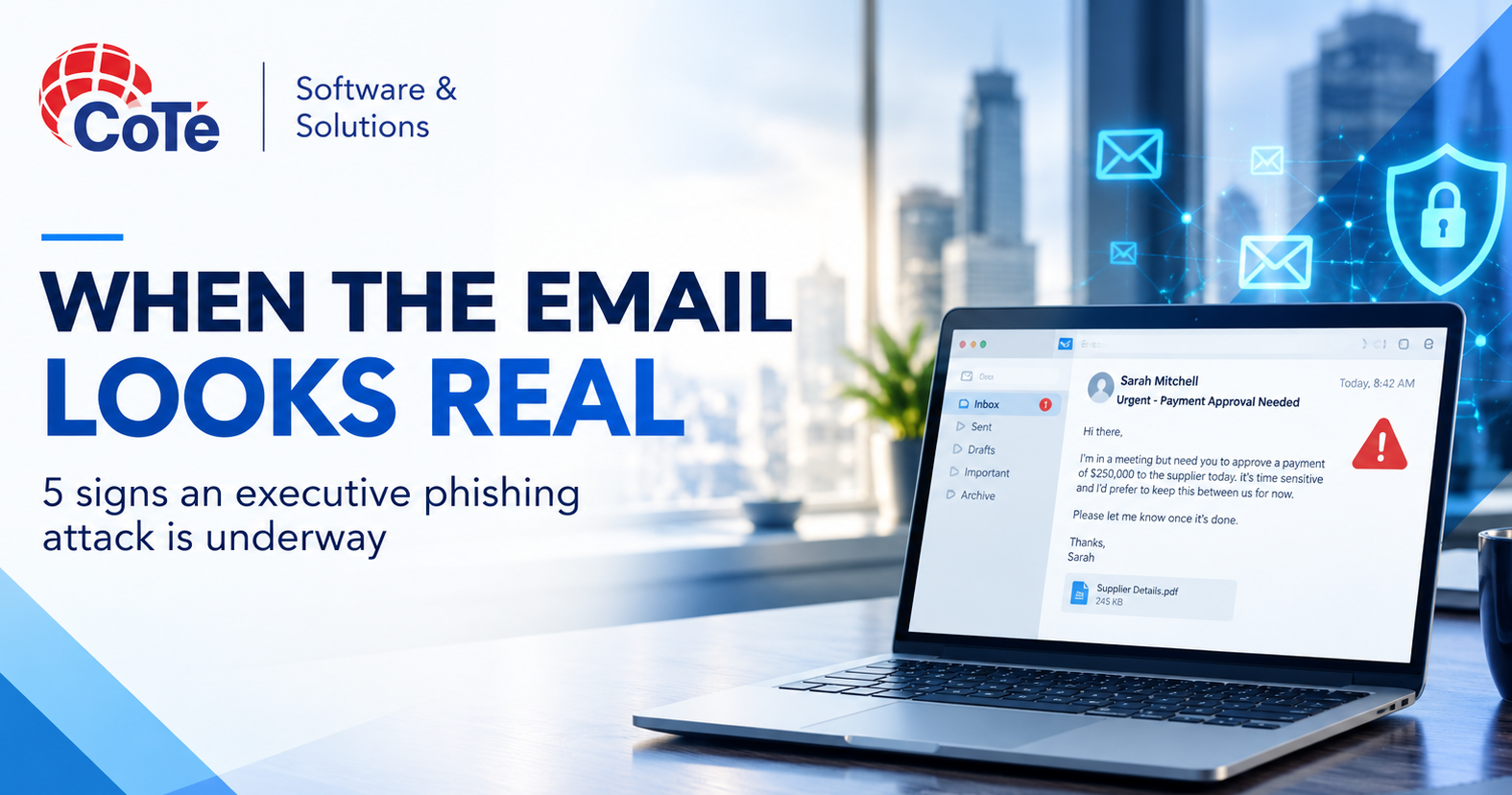
When the Email Looks Real: Five Signs an Executive Phishing Attack Is Underway
Phishing used to be relatively easy to spot. Poor spelling, strange email addresses and obviously suspicious links were often enough to raise a red flag.
That has changed.
Today’s phishing and social engineering attacks can be highly convincing. They may use familiar branding, realistic language, publicly available information and even the name of someone you know.
For executives, the risk is particularly high. Attackers aren’t necessarily just looking for a password – they may be looking for access to sensitive information, financial authority or the ability to influence business decisions.
For organisations managing sensitive information every day, security needs to extend beyond the inbox. At CoTé, we believe secure technology should help organisations maintain control over information, users and business processes – not simply react when something goes wrong.
So, what should executives look for?
1. An Unexpected Request Involving Money or Sensitive Information
Be cautious when an email asks you to transfer funds, approve a payment, share confidential information or provide access to a system – particularly when the request is unexpected.
This is especially important when the request involves changing bank details, approving an invoice or sharing information that would normally require a formal process.
Ask yourself: Was I expecting this request, and does it follow our normal approval process?
The same principle applies to the technology supporting those processes. CoTé’s approach to secure information management is built around controlled access, permissions and governance, helping organisations ensure that sensitive information is available to the right people – and protected from the wrong ones.
2. Pressure to Act Immediately
Urgency is one of a scammer’s most effective tools.
Messages such as “I need this completed immediately,” “I’m about to board a flight,” or “Please don’t delay this” are designed to reduce the time you have to think and verify.
A legitimate business request should not normally require you to abandon sensible security controls.
Ask yourself: Why is this so urgent, and what happens if I take five minutes to verify it?
Good security isn’t about slowing business down. It’s about creating trusted processes that allow people to move quickly without removing important safeguards – something CoTé focuses on through secure, governed workflows.
3. A Request to Change Normal Procedures
Attackers often try to convince people to make an exception.
They may ask you to bypass an approval process, use a personal account, send information outside the organisation or make a payment differently from usual.
For an executive, this should be a significant warning sign. Security procedures exist precisely because trusted people can be impersonated.
Ask yourself: Would I normally approve this in this way?
This is where having structured digital workflows can make a real difference. Rather than relying solely on email instructions, CoTé helps organisations build controlled processes around approvals, access and information sharing, providing greater visibility and accountability.
4. A New or Unusual Communication Channel
A conversation that starts by email may suddenly move to text, WhatsApp or another messaging platform.
The attacker may claim they’re having trouble accessing their usual account or simply suggest a faster way to communicate.
Changing communication channels can make verification more difficult – and can help an attacker avoid established security controls.
Ask yourself: Can I independently confirm that this person is actually who they say they are?
When sensitive documents need to be shared, moving them through secure, controlled platforms rather than informal channels can also reduce unnecessary exposure.
CoTé’s secure information-sharing capabilities are designed to give organisations greater control over how sensitive information is delivered, accessed and managed.
5. A Request That Cannot Be Independently Verified
This is perhaps the most important warning sign.
If a request involves money, sensitive information or significant business consequences, verify it using a trusted method – not the contact details provided in the suspicious message.
Call the person using a known number. Start a new email conversation using a verified address. Speak to finance, IT or another appropriate colleague.
The goal isn’t to prove that the email is fake.
It’s to prove that the request is genuine.
That philosophy also sits at the heart of effective information security: trust should be supported by controls, visibility and verification.
CoTé’s security approach is underpinned by recognised security frameworks, including ISO/IEC 27001 and SOC 2 Type II, helping provide assurance that security and governance are considered throughout the technology environment.
Don’t Judge an Email by How Professional It Looks
Modern phishing attacks don’t necessarily look suspicious.
Perfect grammar doesn’t make an email legitimate. Familiar branding doesn’t make it legitimate. And seeing the name of someone you know doesn’t mean the message actually came from them.
The better question for an executive is not:
“Does this email look legitimate?”
It’s:
“Does this request make sense?”
When money, sensitive information or access is involved, trust should be verified – not assumed.
And the same principle applies to the systems organisations rely on every day.
Security shouldn’t be an afterthought added to technology. It should be part of how information, people and processes are managed from the beginning.
That’s the approach CoTé brings to secure business technology – helping organisations manage information with greater control, visibility and confidence, backed by security practices aligned with ISO/IEC 27001 and SOC 2 Type II.
Executive Takeaway
Your greatest defence against sophisticated phishing isn’t spotting every fake email.
It’s having the discipline to pause, question unusual requests and independently verify them before acting.
Because when your technology is designed around security, governance and accountability, you’re not just protecting against today’s phishing email.
You’re building a more resilient business.