
A document doesn’t become well governed just because it travels through a secure channel. For secure document sharing in Australian financial services, access, approvals and workflow matter too. Assess how documents move between advisers, clients and internal teams.
Scattered channels and unclear responsibilities create friction. Security claims also need to be tested against your organisation’s governance requirements.
This guide helps you set evaluation criteria, compare sharing approaches and decide whether CoTé Share suits your document workflows.
Key Takeaways
- Map how statements, applications and supporting records move between advisers, clients and internal teams before choosing a sharing approach.
- Assess identity, permissions, oversight and document handling separately, and ask for clear evidence behind security claims.
- Compare secure file sharing, client portals and email-led processes against your organisation’s user journeys and governance needs.
- Use a practical evaluation matrix to record each requirement, its supporting evidence, the accountable owner and the decision.
- Decide whether CoTé Share suits your workflow requirements.
Why secure document sharing matters in Australian financial services
An adviser sends a client an application. The client returns it with identity records and supporting documents. An internal team reviews the material, requests a correction or passes it to another colleague. Each hand-off is part of the service, but every channel and copy adds another place to manage. Secure document sharing starts with understanding this real exchange, not with a product feature list.
Secure document sharing is the controlled digital exchange of documents between authorised parties, with defined access and handling processes. It is more than attaching a file to an email. The aim is to manage how documents move between clients, advisers and internal teams throughout a business workflow.
Where document exchanges create operational friction
Follow a document from start to finish. An adviser might send a form, a client might return it by email, and a support team might save a copy to another location for review. If someone then requests an updated statement, the adviser needs to know which copy is current and who is responsible for the next step.
Duplicates create uncertainty. One team member might work from an older version while another searches a mailbox for the latest attachment. Staff can lose time locating records, identifying the owner of an approval or clarifying whether a document has been received. These are workflow problems: they concern hand-offs, ownership and retrieval.
Security controls are a separate question. They concern who is authorised to access information, how it is protected and what evidence supports the organisation’s approach. A process can be orderly but still need stronger controls. A secure channel, on its own, won’t fix an unclear approval path.
What secure document sharing should help control
Assess three areas separately:
- Access: Which clients, advisers and internal roles need to view or provide documents? Define the intended audience and the basis for access.
- Document handling: How will teams identify the relevant version, pass documents between people and retrieve them when the workflow requires it?
- Governance: Who owns approvals and process decisions? What records or evidence does the organisation need to review its approach?
These questions matter across Australian financial services, including advice, wealth management and insurance. The regulatory environment includes different bodies and legislation, so organisations should assess their own obligations with the appropriate internal specialists. ASIC provides an overview of its role in financial regulation in Australia.
Software supports governance. It doesn’t make an organisation compliant. A sound evaluation separates the product’s documented capabilities from the organisation’s policies, responsibilities and compliance assessment. That distinction helps decision-makers judge whether secure document sharing supports their requirements without treating a security claim as proof of compliance.
Which security and governance requirements should a solution support?
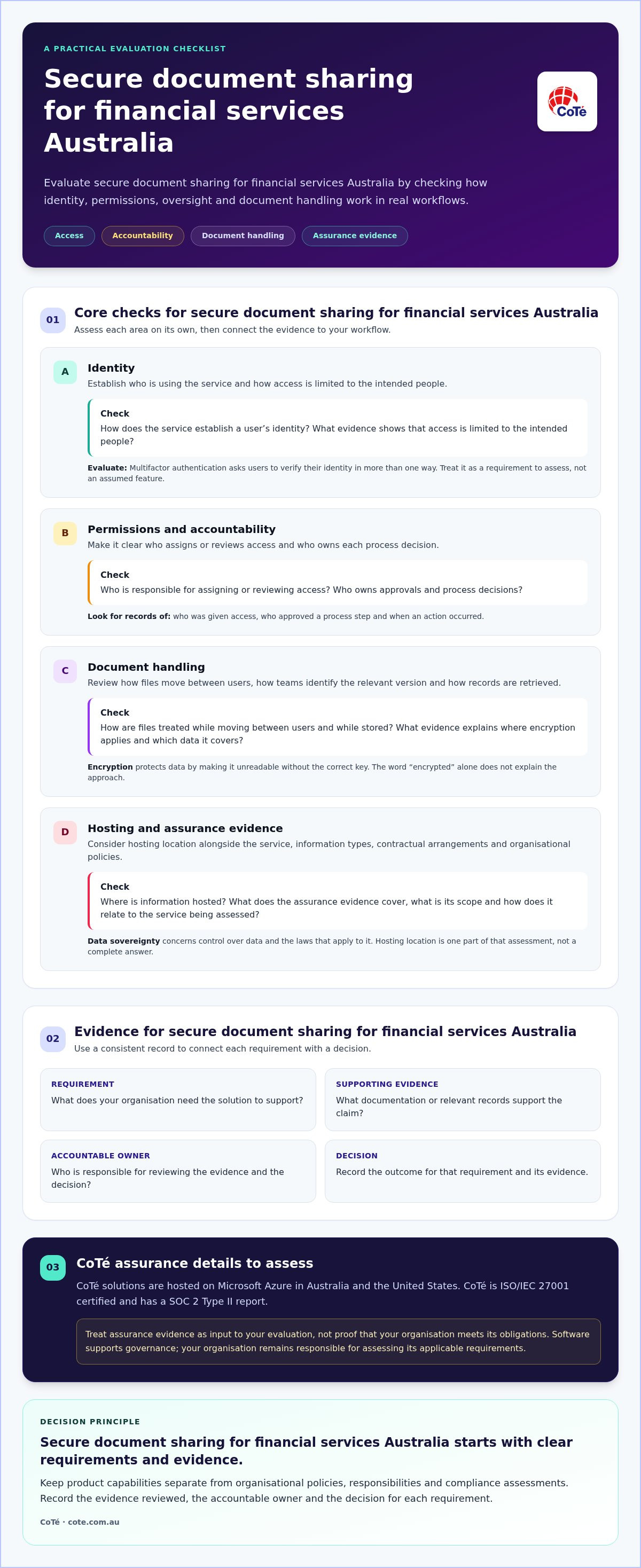
Set the requirements before comparing product claims. Assess four areas: identity, permissions, oversight and document handling. Then ask for evidence that relates to each requirement. A polished security summary is not enough. Decision-makers need to understand what a solution does, how it is assessed and where the organisation must set its own policies.
Assess access controls and accountability
Start with identity. How does the service establish who is using it? What evidence shows that access is limited to the intended people? Treat multifactor authentication, which asks users to verify their identity in more than one way, as a requirement to evaluate, not an assumed feature.
Next, examine permissions and oversight. Identify who assigns or reviews access, and what records are available to support internal review. Consider the decisions your teams need to trace, such as who was given access, who approved a process step and when an action occurred. Ask for examples of relevant records and how they are generated. This links a control to an actual adviser, client or operations workflow.
Document handling needs its own review. Ask how the solution treats files while they move between users and while they are stored. Encryption is a method of protecting data by making it unreadable without the correct key. Request precise evidence about where encryption applies, which data it covers and how the provider documents the approach. The word “encrypted” on its own leaves too much unanswered.
Assess hosting and assurance evidence
Confirm where information is hosted and what that means for your organisation’s requirements. Hosting location is one part of the assessment, not a complete answer on data sovereignty, which concerns control over data and the laws that apply to it. Consider the service, information types, contractual arrangements and organisational policies together.
For example, CoTé solutions are hosted on Microsoft Azure in Australia and the United States. CoTé is ISO/IEC 27001 certified and has a SOC 2 Type II report. These are evidence for evaluation, not proof that a customer meets its obligations. Ask what the evidence covers, its scope and how it relates to the service being assessed.
Security assurance evidence describes assessed controls; compliance outcomes depend on how the organisation meets its applicable obligations. Keep those judgements separate. The OAIC’s overview of the Australian Privacy Principles is an official starting point for understanding the principles. Your organisation should assess which requirements apply to its activities and seek appropriate advice where needed.
Record each requirement, the evidence reviewed and the person responsible for the decision. That gives governance, security and operations teams a shared basis for evaluating CoTé Share’s secure file-sharing application against their needs.
How to compare secure sharing with a client portal or existing process
Choose by document journey, not by label. Secure document sharing could involve a dedicated file-sharing application, a broader client portal or a current email-led process. These approaches serve different purposes. A sharing application and a full portal are not automatically interchangeable, so compare them against the work clients and staff need to complete.
Use this table to frame the assessment. It describes typical purposes, not guaranteed features. Confirm the actual scope of each proposed solution and process.
| Approach | Purpose and user journey | Workflow fit and governance evidence | Scope to assess |
|---|---|---|---|
| Secure file sharing | Centres on exchanging documents between an organisation and its clients or teams. | Assess how the exchange fits preparation, review, approval and retrieval. Request evidence relevant to your governance requirements. | Document exchange, rather than assuming it covers the entire client service experience. |
| Client portal | Provides a client-facing point of interaction. The specific purpose and journey depend on the portal’s intended scope. | Assess how document exchange sits alongside other client interactions and internal steps. | A wider service experience, not simply another name for file sharing. |
| Email-led process | Uses email to send and receive files within existing adviser-client communications. | Map how staff manage hand-offs, approvals and records across the process. Review the evidence available to support oversight. | An established communication method that might not provide a single, defined document workflow. |
Match the tool to the document journey
Map one document type at a time. Record who prepares it, who approves it, how it reaches the client, who receives it back and where staff retrieve it later. Then place each exchange within the wider service experience. A client might need to provide a document as one step in an advice or insurance process, while the organisation’s portal serves broader client interactions. Keep essential workflow and governance requirements separate from attractive extras that don’t solve a defined problem.
Test operational fit before making a decision
Walk advisers and operations staff through the proposed process using representative tasks. Check that responsibilities and existing approval steps have a clear place, and define what the evaluation must demonstrate for each role. Record any unresolved requirement as a project decision with an owner and next action. Don’t treat an untested assumption as a product capability. CoTé Share is a secure file-sharing application for business document exchange, and its scope can be assessed against this workflow.
A practical buying framework for financial services teams
Turn the requirements into a decision process. Use four steps: map documents, set controls, assess evidence and test workflow fit. This order keeps the evaluation grounded in real adviser-client exchanges rather than broad feature claims.
Turn operational needs into testable requirements
Choose representative scenarios, such as sending an application to a client, receiving supporting records and routing documents for internal review. For each scenario, map the people involved and what needs to happen. Then write requirements that a team can assess, not vague goals such as “strong security” or “easy to use”.
- Map documents. Record the document types, users, hand-offs and retrieval needs in each scenario.
- Set controls. Define requirements for identity, permissions, oversight, hosting and document handling.
- Assess evidence. Match product and provider documentation to each requirement. Note what the evidence covers and where it leaves questions.
- Test workflow fit. Walk advisers and operations staff through the proposed process. Record where roles, approvals or client steps need to change.
Assign a business owner to workflow and client experience requirements, a technology owner to technical assessment, and a governance owner to assurance and oversight. Some organisations will assign more than one role to a person, but each requirement still needs a clear accountable owner.
Review evidence and make a defensible decision
Use an evaluation matrix to keep the assessment consistent. For each requirement, record the evidence reviewed, the owner and the decision. Add a notes field for limitations, assumptions and follow-up actions. This creates a clear record for stakeholders who need to understand why a solution was selected or why a requirement remains unresolved.
| Requirement | Evidence | Owner | Decision |
|---|---|---|---|
| Access for intended users | Documentation and scenario test | Technology or security | Meets, does not meet or unresolved |
| Fit with adviser approval steps | Workflow walkthrough | Business owner | Meets, does not meet or unresolved |
| Governance review needs | Assurance material and internal assessment | Governance owner | Meets, does not meet or unresolved |
Include implementation ownership and user adoption in the decision. Identify who will oversee the change, how staff will learn the process and when governance teams will review whether it still meets organisational needs.
Consider CoTé Share for secure document sharing
Once your requirements and workflow map are clear, compare them with a specific product. Share is CoTé’s secure file-sharing application, part of its enterprise software offering for document-heavy industries. It is designed for business document exchange. Assess it against the document journeys your organisation needs to support, rather than assuming it replaces a broader client portal or every existing process.
Connect the product to the buying criteria
CoTé is Australian-built. Treat the hosting and certification details above as evidence for your evaluation. They help inform governance discussions, but they don’t establish that a particular organisation meets its compliance requirements.
Bring your evaluation matrix to the assessment. For each requirement, compare the available product evidence with the outcome your teams need. Keep confirmed information separate from assumptions. For example, if a requirement relates to how a client exchange fits an approval step, assess that workflow directly instead of inferring a capability from a general security statement.
Keep the review specific to your organisation. Advisers can assess whether the proposed exchange fits their client interactions. Operations teams can consider how it sits within document handling and retrieval. Governance and technology stakeholders can review the relevant evidence against their own requirements. Record any open question as a decision to resolve, not as an assumed product feature.
Make the next step a clear one
The strongest next step is a focused assessment, not a broad technology project. Start with one document workflow that matters to your teams. Agree what the client and staff need to do, then compare the process with your governance requirements and the evidence available. That gives decision-makers a practical basis for deciding whether secure document sharing fits the organisation’s needs in Australian financial services.
Keep the decision proportionate. If the priority is business document exchange, assess CoTé Share against that defined purpose and record any remaining questions for your evaluation. A clear scope makes it easier for business, technology and governance stakeholders to work from the same decision criteria.
Ready to assess your first document workflow? Request a CoTé Share demo.
Frequently Asked Questions
Is Australian hosting enough to establish data sovereignty or compliance?
No. Australian hosting identifies a data location, but it doesn’t establish data sovereignty or show that an organisation meets its obligations. Assess where primary information and backups sit, who can access them, what contractual terms apply and how operations are managed. Bring technology, privacy and governance stakeholders into the review. Consider each factor in the context of your organisation’s services and information, rather than treating location as a complete assurance decision.
Can secure document sharing replace a financial adviser client portal?
Not automatically. A sharing application centres on document exchange, while a portal can support a broader digital service experience. For example, an organisation might use a portal for ongoing client interactions and assess a separate approach for a specific document exchange. List the tasks clients need to complete, then decide which tool or combination fits. This prevents a document-sharing requirement from expanding into a portal replacement project without a clear business case.
How should an organisation assess security certifications and reports?
Review the credential’s exact scope, the service it covers and the evidence available to support it. Then compare that material with your organisation’s requirements and record any gaps or assumptions. A certification or report provides assurance evidence; it doesn’t determine whether your organisation meets its obligations. Ask internal security and governance teams to interpret the material and document how their findings inform the selection decision.
What should happen when a client relationship ends?
Follow an organisation-owned process for reviewing access, responsibilities and document retention when a relationship changes or ends. For instance, a client transfer between advisers should trigger a review of who needs access and who is responsible for the next step. Assign an owner, record the decision and apply the organisation’s policies and relevant obligations. During software evaluation, assess whether the proposed process is supportable instead of assuming a specific feature exists.
Should financial services teams include advisers in a software evaluation?
Yes. Advisers see where client tasks create friction, while operations teams understand the work that follows each exchange. Include technology and governance stakeholders to cover technical evidence and oversight needs. Test a representative scenario, such as a client returning an incomplete form, and note how each role handles it. Record observations against agreed criteria so the decision reflects working practice, not preference alone.
Disclaimer
This article provides general information only and does not constitute legal, compliance or professional advice. Consider your organisation’s specific obligations and seek appropriate advice before making decisions.