
Warning signs that customer communications are building risk include outdated content, conflicting versions, approval gaps, unexplained edits, delivery blind spots, repeated customer confusion, manual corrections and missing decision records. These signals often overlap: a delayed approval can leave old information in circulation, while fragmented records make it harder to see who received what. Teams may spot each issue in isolation and still miss the wider pattern.
Customer communication problems rarely sit neatly within one team or system. A message can be accurate when drafted, altered during approval, sent through the wrong channel and difficult to trace afterwards. The result can be operational friction, confused customers and less confidence that important communications are under control.
This article explains how warning signs emerge together, why teams miss them or delay action, and how communication breakdowns contribute to risk. You’ll learn what to look for across content, approvals, delivery and record-keeping, so you can distinguish a one-off fault from a process that needs attention.
Key Takeaways
- Assess warning signs across different parts of the operation. Several types appearing together deserve more attention than one isolated issue.
- Look at the order in which problems emerge. Early operational changes can offer a chance to act before commercial impact becomes obvious.
- Reduce information clutter and make escalation ownership clear, so important signals don’t get normalised or lost.
- Trace how a customer communication moves from drafting to delivery. Gaps between teams and systems can compound risk.
- CoTé’s Virsaic Enterprise supports document composition, workflow approvals, signatures and multi-channel delivery.
How warning signs build together
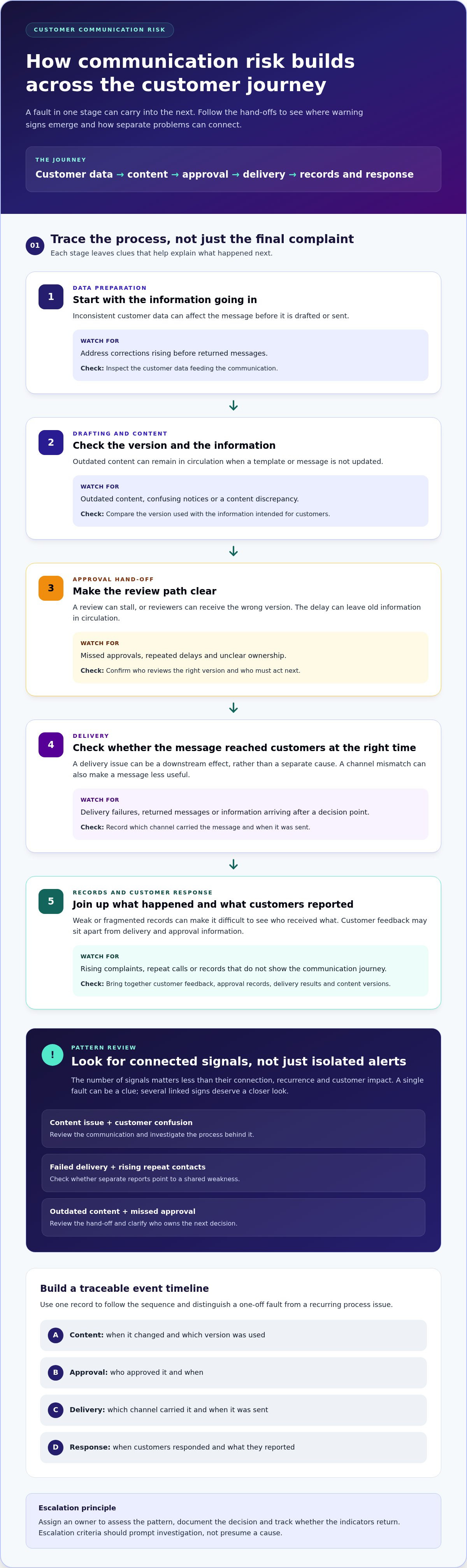
Customer communication risk rarely starts with one obvious failure. It develops across connected steps: data preparation, drafting, approval, delivery and record-keeping. A policy update might use an outdated template, stall during approval and reach customers after a newer version takes effect. Because each fault may have a different owner, teams can treat them as separate incidents. Warning signs that customer communications are building risk often emerge across these hand-offs.
Track the sequence, not just the final complaint. If address corrections rise before returned messages, inspect the customer data feeding the campaign. If approval delays follow, check whether reviewers receive the right version and know who must act. A later delivery problem may be a downstream effect, not a separate cause.
Compare indicators across teams and channels. A service team might record repeat calls about a confusing notice, while the communications team sees no delivery fault. A complaints team may log the same issue under another category. Bring together customer feedback, approval records, delivery results and content versions. That joined-up view can reveal whether separate signals share a process weakness.
Use an event timeline. Record when content changed, who approved it, which channel carried it and when customers responded. For an emergency notice, include the operational trigger and the version sent. This helps distinguish a late dispatch from a recurring approval bottleneck and shows whether teams acted before customer impact became visible.
Set escalation criteria around combinations of signals, not isolated alerts. Review a customer notice when outdated content and missed approval appear together. If rising complaints or delivery failures also emerge, investigate the wider process. The number of signals matters less than their connection, recurrence and customer impact. Assign an owner to assess the pattern, document the decision and track whether the indicators return.
Timing helps separate cause from symptom. A missed review can precede an incorrect message, while customer confusion may appear only after dispatch. Review trends alongside individual incidents to spot repetition. Keep dates, versions and decisions in one traceable record. This gives operational leaders a clearer basis for action than scattered reports or memory, and helps reveal how communication failures compound risk.
Why teams miss the warning signs
Signals get missed when teams see separate categories instead of one customer journey. A contact-centre manager might record repeat calls, while a communications team logs delivery errors. If those records sit in different systems, neither team sees that customers are reacting to the same notice. The warning is present, but divided between owners.
Alert overload creates another barrier. When routine alerts, approval requests and serious exceptions share one inbox, a manager can overlook an urgent issue among ordinary updates. More alerts do not help if urgent signals look familiar.
Define clear categories for communication incidents. Separate content errors, approval delays, delivery failures and customer confusion. Then name the owner for each category and the person responsible for connecting trends across them. For example, a wrong account balance in a letter needs content review, while repeated undelivered messages point to data or channel handling. Distinct categories guide action without hiding connections.
Normalisation also delays decisions. If a notice repeatedly misses its scheduled release, staff can begin treating the delay as routine. Managers may then adjust expectations rather than address the approval bottleneck. Record the original deadline, actual release and reason for each delay. A recurring gap is harder to dismiss when the timeline shows a consistent pattern.
Unclear authority stalls escalation. A frontline employee might recognise a serious customer impact but lack permission to pause a communication. A reviewer might identify a defect yet assume another team owns the decision. Set out who can stop a release, who must be notified and who records the outcome. For an emergency message, clarify the decision path before an incident occurs.
Teams also wait for certainty. A single complaint can seem anecdotal, and an isolated delivery failure can look technical. Rather than waiting for proof of widespread harm, define what combination of signals warrants review. For instance, pair a content discrepancy with customer confusion, or failed delivery with a rising repeat-contact pattern. The trigger should prompt investigation, not presume a cause.
Test the process with a realistic example. Ask a service manager to report a confusing letter, then trace who receives the report, who assesses the risk and how the decision reaches the communications team. Note every hand-off and delay. If the route depends on personal contacts or an absent specialist, the process itself is a barrier. A documented escalation path gives staff a practical next step.
Where communication breakdowns start
A communication breakdown often starts at a hand-off. A product team changes a fee, but the customer notice still uses the previous wording. The contact centre then answers questions using another version. Customers receive conflicting information, while each team believes its own copy is current.
Trace a message from source to delivery. Record the approved content, its owner, the release channel and the final version. For example, compare the email sent to customers with the document stored in the service team’s folder. A mismatch shows where control slipped, not just where someone noticed it.
Channel changes add their own failure points. A detailed letter might become a short SMS, but the shorter text can lose a condition or a next step. Test each format against the same critical facts. Check the customer action, deadline and contact route before the message moves between email, post and mobile channels.
Temporary workarounds can also become permanent without a clear replacement step. A team might send a manual correction after finding an error, then forget to update the source template. The next campaign repeats the mistake. Log each temporary fix with an owner, a resolution date and the system or content that needs correction.
Regulatory communications need traceable decisions. Keep the approved wording, reviewer comments and release record together. If a customer challenges a notice, staff should be able to identify what was sent and why. A file name such as “final” does not establish which version passed review. Use a controlled version reference and record the approver.
Build a hand-off check around the failure itself. Confirm the source data, content version, approval, channel rendering and delivery record. For a changed payment instruction, compare the approved details with the customer-facing message and the service team’s script. Record who resolved any differences before release.
When teams rely on scattered files and informal updates, breakdowns are harder to isolate. A shared workflow gives staff a defined route for content review and approval, while keeping each step visible to its owners. If those hand-offs are difficult to map, discussing your communications workflow is a practical next step.
The 8 warning signs to look for
Look for evidence in the communication itself and the process around it. These warning signs help distinguish isolated mistakes from weaknesses affecting multiple messages, teams or channels. Use a recent customer notice as a sample, then trace its content, approval and delivery records.
- Outdated content: A letter refers to an old product name or process. Compare it with the current approved source and note where the obsolete wording remains available.
- Conflicting versions: A website explains one process while a statement describes another. Compare the customer-facing versions and identify which team owns the source content.
- Approval gaps: A notice has no clear record of review or authorisation. Trace its route and identify the step where responsibility became unclear.
- Unexplained edits: The final message differs from the approved draft. Compare both versions and record what changed, who changed it and whether the change received review.
- Delivery blind spots: A team records dispatch but cannot establish which message reached which customer. Compare available delivery records with the intended audience and channel.
- Repeated customer confusion: Customers contact staff to clarify the same instruction. Review the wording and service scripts to see whether both explain the next action consistently.
- Manual corrections: Staff send follow-up messages to fix recurring mistakes. Record each correction and identify whether the cause sits in data, content, approval or channel handling.
- Missing decision records: Teams cannot explain why a message was changed or released. Trace the decision history and note any hand-off that relies on memory instead of a recorded step.
Test the signs against a real example, such as a renewal notice that prompts calls about an unclear payment date. Check the approved wording, the version sent and the response staff gave. If those records disagree, the issue goes beyond one awkward sentence. It points to a control gap that needs an owner and a documented fix.
Record each finding with its evidence, customer impact and next action. A clear entry such as “the statement uses the previous payment date” gives teams something to resolve. A label such as “communication issue” does not identify the content, process or record that needs attention.
Then act on each finding: assign an owner, retain the supporting record and set a review point. Check that the correction was made in every version and channel, and that staff can find the approved replacement. Close the finding only when the record and the customer-facing message can be checked together.
When to escalate immediately
Some communication faults need immediate containment, not routine correction. A message sent to the wrong customer, an incorrect payment instruction or a notice that exposes another person’s details creates direct customer impact. Stop further distribution where possible, preserve the message and delivery record, then alert the accountable manager. Record what went out, who received it and which channels remain active.
Escalate when three or more warning signs from different categories appear together. For example, a content error, an approval gap and a spike in customer complaints point to connected weaknesses. Treat that combination as a trigger for independent assessment, rather than waiting for one team to prove the entire cause. The categories help frame the review: content, process, delivery and customer response.
Repeated deadline slippage is another danger signal. If a critical customer notice repeatedly misses its release date, staff might start treating delay as normal. That assumption can leave customers without information they need to make a decision. Compare the planned release with the actual dispatch, identify the blocked approval or data dependency, then assign an owner and a corrective action.
Watch for unresolved contradictions. A customer statement might show one amount while a service script gives another. A policy notice could describe an option that staff no longer recognise. These mismatches make the next customer interaction harder to manage. Pause the affected communication, align the source content and frontline instructions, then record which version is authoritative.
Missing evidence also raises the risk level. If an organisation cannot identify the approved version, intended audience or actual dispatch, it cannot reliably establish what customers saw. Gather the available content, approval history and delivery records. Note any gaps without filling them through assumption. A clear evidence trail supports a focused investigation and more accurate customer follow-up.
Set severity using impact and reach, not the volume of internal discussion. One incorrect message about an urgent action can outweigh numerous minor formatting defects. Consider whether the content could prompt a harmful decision, whether it went to the wrong audience and whether customers need a correction. Document the rationale, owner and next review point for each escalation.
Once contained, examine the failed control. Determine whether the source content was wrong, an approval step failed or the channel altered the message. Tie corrective action to the identified cause, then review similar communications for the same weakness. Record the decision and follow-up owner so the fix becomes part of the operating process, not an informal reminder.
CoTé: Virsaic Enterprise
Virsaic Enterprise is CoTé’s enterprise Customer Experience Management platform, supporting document composition, workflow approvals, signatures and multi-channel delivery. It helps organisations review how customer messages move from preparation through approval and dispatch, particularly when several teams or channels are involved. Its controlled workflows make responsibilities and hand-offs clearer, supporting governance requirements alongside sound processes and human oversight.
CoTé’s software is Australian-built and hosted on Microsoft Azure in Australia and the United States. CoTé is ISO/IEC 27001 certified and has a SOC 2 Type II report.
Ready to trace your customer communications from draft to delivery? Request a Virsaic Enterprise platform demo.
Frequently Asked Questions
How should teams organise a communications risk review?
Use a sample of recent customer communications, grouped by product, audience and channel. Include people from content, operations and customer service so the review captures both process decisions and customer responses.
How can an organisation tell a one-off mistake from a wider weakness?
Compare the incident with other messages using the same source data, template or approval route. A shared cause across different communications points to a process issue, while a fault limited to one item may have a narrower cause.
What should an incident record capture?
Record the affected communication, audience, channel, discovery point, customer impact and actions taken. Include the decision owner and any follow-up needed, so a later review can assess whether the response addressed the cause.
Who should own the review of recurring communication problems?
Assign a named operational owner with authority to bring relevant teams together. Content specialists can explain wording and approvals, while service teams contribute customer feedback and operational context.
Disclaimer
This article provides general information only and does not constitute legal, compliance or professional advice. Consider your organisation’s specific obligations and seek appropriate advice before making decisions.