
Regulatory correspondence is more than a letter to file away. It includes written and electronic exchanges with authorities about investigations, audits, complaints and information requests. Managing compliance correspondence means keeping these exchanges organised so your organisation can track deadlines, responses and outcomes.
That sounds straightforward until a notice lands in one team’s inbox while the records and decision-makers sit elsewhere. A missed handover can make it harder to understand what the authority needs and how the response is progressing.
This article explains what correspondence with authorities covers in Australia and how internal records, ownership and review processes help keep it under control. You’ll learn what a compliance notice sets out, which Australian laws may apply to regulatory activity and how to manage communications across jurisdictions. The focus is practical: understand the request, keep the evidence together and make the response traceable.
Key Takeaways
- Keep authority letters, evidence, owners and response status together so teams can see what needs action.
- Use a consistent recordkeeping process across jurisdictions to reduce fragmented files and conflicting responses.
- Record the regulator, statute and provision cited in each notice so the right team reviews the response.
- Read a compliance notice for the required action, due date, requested records and instructions for providing them.
- CoTé’s Virsaic Enterprise platform supports document composition, workflow approvals, signatures and multi-channel delivery.
Internal processes for managing compliance correspondence
Regulatory correspondence includes notices, audit records, complaint referrals and information requests. A clear internal process gives every item an owner, a response path and a recorded outcome.
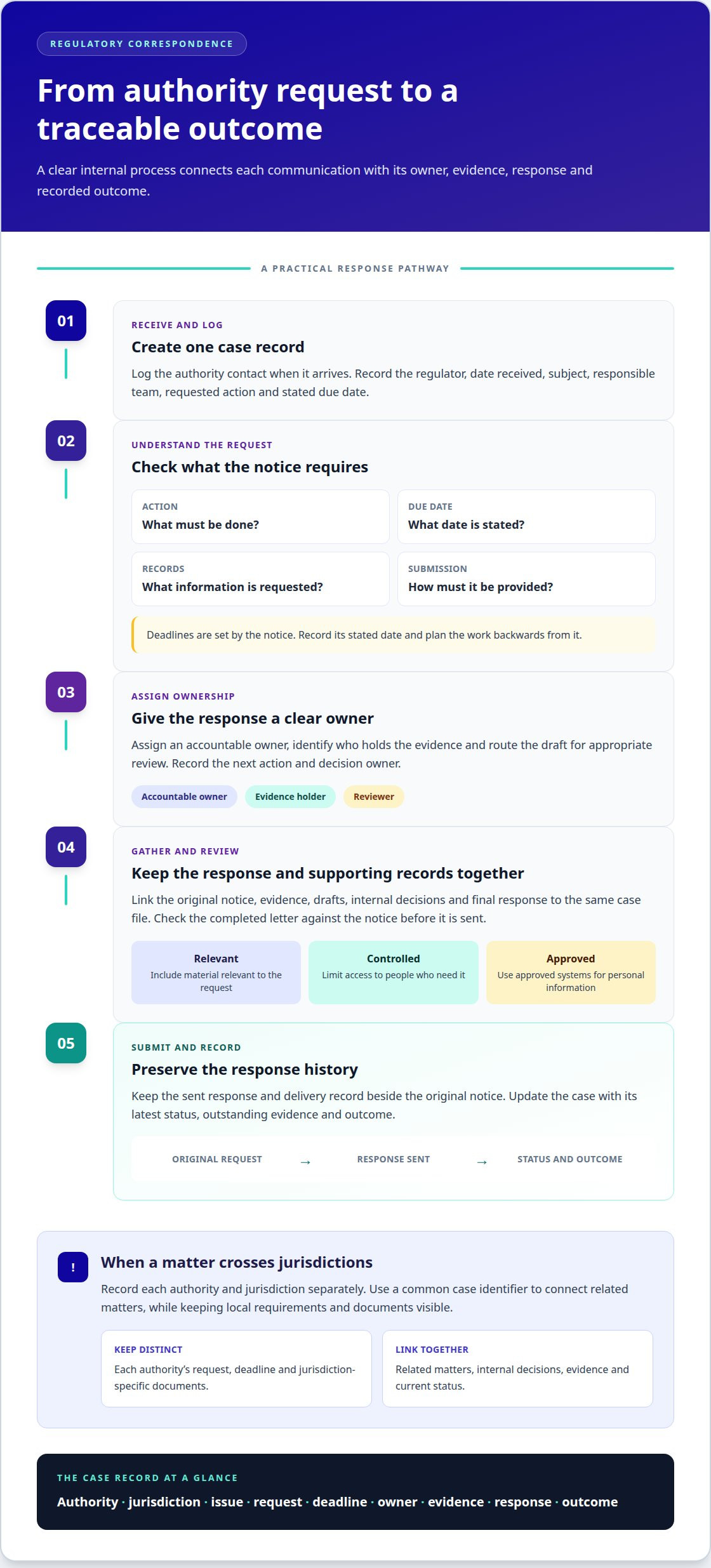
Log each authority contact when it arrives. Capture the regulator, date received, subject, responsible team, requested action and stated due date. Link supporting records and drafts to the same case file. This gives legal, compliance and operational teams a shared view of the response instead of scattered email threads and competing document versions.
Responding to compliance notices
A compliance notice sets out what the recipient must do, the due date, the information or records to provide and how to submit them. Assign an accountable owner, confirm each requested item and route the draft response for appropriate review. Deadlines are set by the notice, not by a universal timetable, so record the stated date and plan the work backwards from it.
Missing a regulator’s deadline can lead to fines, penalties or legal consequences. The outcome depends on the regulator’s powers and the circumstances. An internal log helps teams spot delays, escalate unresolved requests and preserve a record of each action.
Protect privacy and confidentiality by limiting correspondence and attachments to people who need them for the response. Store personal information in approved systems and include only material relevant to the request. Retention should follow the organisation’s applicable recordkeeping obligations and the purpose of each record, rather than a single period for every regulator file.
Compliance letter templates and guidance
Use guidance and templates published by the regulator handling the matter, where available. They help teams structure a response around that authority’s request and process. Guidance is not a substitute for reading the notice and answering its specific requirements.
Maintain an approved internal template for recurring tasks, such as acknowledging receipt, listing enclosed records or answering point by point. Keep regulator-specific requirements separate, then have the responsible reviewer check the completed letter against the notice before it is sent.
For each open matter, record the latest status, next action, decision owner and any outstanding evidence. Keep the sent response and delivery record beside the original notice. This creates a traceable history for audits, investigations and later complaints, while helping leaders see where a request is stalled and who needs to move it towards resolution.
Managing correspondence across jurisdictions
For organisations operating across borders, regulatory correspondence includes written and electronic exchanges with local or global authorities. It may concern investigations into business activities, audits, complaints or information requests. A central process helps teams identify the jurisdiction and regulator for each matter, then route it to the people responsible for that market.
Start by separating matters by authority and jurisdiction. Record the regulator, affected business unit, subject, date received, response deadline and accountable owner. Then link the original communication, evidence, internal decisions and final response to one case record. For example, an investigation involving an Australian operation and related overseas activity needs a clear record of which authority asked each question.
Keep local requirements visible. Maintaining records helps an organisation identify regulatory compliance requirements across jurisdictions and assess how they affect operations. A shared register should not flatten those differences into one generic response. Use the relevant notice and regulator’s requirements to guide each response, while linking related matters so teams can see where an issue crosses borders.
Control deadlines separately. Each authority sets its own response dates. Record the deadline stated in each communication, identify who owns the evidence and escalate delays before the due date. A deadline calendar grouped by jurisdiction helps teams distinguish obligations, especially when several authorities investigate related activities.
Inconsistent handling creates another risk. If Australian and overseas teams work from different files, they may give conflicting accounts or take misaligned actions. Use a common case identifier and log each authority’s request, response and current status. Keep jurisdiction-specific documents together while making related cases visible to the central compliance team.
Organise each case record into practical fields: authority, jurisdiction, issue, request, deadline, owner, evidence, response and outcome. This structure helps managers identify open investigations, recurring complaints and matters awaiting resolution. It also supports review of regulatory changes that could affect operational or financial performance, without treating one jurisdiction’s requirements as universal.
Review the register at a scheduled governance meeting. Ask which deadlines are approaching, which authority requests lack evidence and which responses await approval. This turns scattered messages into a useful view of open matters, decisions and resolutions across jurisdictions.
Which Australian laws and regulations govern compliance correspondence?
There is no single Australian law that governs every exchange with a regulator. The issuing authority, industry and subject determine which legislation applies. For example, the Australian Communications and Media Authority (ACMA) carries out compliance and enforcement activities under several Acts, including the Telecommunications Act 1997, the Spam Act 2003 and the Do Not Call Register Act 2006.
Read each notice in the context of the legislation it cites. Record the regulator, statute and provision alongside the matter’s subject, so legal and compliance teams can distinguish one statutory process from another. Where a notice relates to a formal decision or possible enforcement step, route it to legal review early.
What information must a compliance notice or letter include in Australia?
An Australian compliance notice identifies the required action, due date, information or records sought and submission method. Treat these details as the authority’s defined scope, not as a general invitation to send every document connected with the organisation. A focused response keeps the matter manageable and makes it easier to explain why each item is relevant.
Start by identifying the issuing authority and the matter named in the notice. Check whether it refers to a particular service, approval, investigation or activity. This context helps teams locate the right records and avoid mixing material from separate matters. For example, a request concerning a specific licence or approval belongs in that matter’s file, not bundled with unrelated operational correspondence.
Next, assess the wording of the request. Some terms may cover several record types or internal processes. Develop a working interpretation for the response team and record any assumptions that affect what material is gathered. If a phrase has more than one plausible meaning, route it for appropriate internal review rather than letting different teams interpret it independently.
Build an evidence map for the matter. For each response point, note the source system or business area, the record owner and whether the material is complete. This helps reviewers see how the organisation’s evidence supports its account. It also reveals gaps early, before separate teams prepare answers based on different records or inconsistent versions.
Keep the response proportionate to the notice. A clear structure, such as headings that follow the authority’s sequence, helps readers connect explanations with supporting material. Describe technical records in plain language and identify attachments consistently. If an item is unavailable or needs context, explain that clearly in the response rather than leaving an unexplained gap.
Maintain a controlled record of interpretation and review. Keep the source notice, evidence map, supporting files, approved response and submission record together. Restrict access to staff involved in the matter, particularly where attachments contain sensitive information. This creates a traceable record without spreading material across unrelated folders or email chains.
Before finalising the response, compare its structure with the notice and check that each point has a clear answer or supporting document. Confirm that attachments open and use consistent file names. A final review focused on completeness, relevance and clarity helps prevent confusion during assessment and gives the organisation a coherent account of its response.
CoTé: Virsaic Enterprise
Virsaic Enterprise is CoTé’s enterprise Customer Experience Management platform, supporting document composition, workflow approvals, signatures and multi-channel delivery. It gives teams a controlled way to prepare, review and route communications when authority requests, internal reviews and customer correspondence move between teams.
CoTé’s software is Australian-built and hosted on Microsoft Azure in Australia and the United States. CoTé is ISO/IEC 27001 certified and has a SOC 2 Type II report.
Make the next improvement deliberate
Use the next governance review to decide where your regulatory communication process needs to improve. Start with a recurring matter type, then identify hand-offs that cause delays, uncertainty or duplicated work. The aim is not to add another layer of administration, but to make the process fit how your organisation operates, with clear responsibility and a reliable record of decisions.
Keep the improvement practical. Agree which workflow needs attention first, who owns its design and how leaders will review whether it works. This gives teams a defined starting point for strengthening how they manage compliance correspondence, without trying to redesign every process at once.
Ready to bring your compliance correspondence under control? Request a Virsaic Enterprise platform demo.
Frequently Asked Questions
What is correspondence with authorities?
It covers communications between an organisation and an authority about its work or regulatory matters. The exchange may continue beyond the initial contact, with later messages clarifying the authority’s concerns or the organisation’s position. Keep the full thread, including relevant attachments, together so context is not lost when staff change or a matter moves between teams.
What does compliance correspondence mean in Australia?
In Australia, compliance correspondence means communications connected to regulatory oversight or an organisation’s obligations. Use the term to classify a matter, not as a substitute for identifying its actual subject. For example, label a file with the regulator and the issue it concerns so teams can distinguish it from unrelated operational communications and find the right material during an internal review.
How can organisations draft, send and record compliance correspondence?
Keep the response controlled from draft to dispatch. Use a versioned working document, record who approved the final text and preserve the exact copy sent. For electronic delivery, retain the transmission record with the response. This creates a clear history if someone later needs to establish which wording was authorised, rather than relying on a draft saved in an individual mailbox.
How should teams handle a regulator’s follow-up?
Attach follow-up correspondence to the existing matter and identify what has changed: a new question, a request to clarify an earlier answer or a request for additional material. Route the point to the relevant subject-matter owner and keep the prior response available for context. This helps teams address follow-ups directly without losing continuity or creating a disconnected file.
How does compliance correspondence differ from a warning, show-cause notice or enforcement notice?
Compliance correspondence is the broader category of written and electronic exchanges with authorities, including information requests, audit records and complaint referrals. A warning, show-cause notice or enforcement notice is a specific formal step that may carry consequences and set a response deadline. Identify the notice type and the provision it cites, then route it to legal review before responding.
Disclaimer
This article provides general information only and does not constitute legal, compliance or professional advice. Consider your organisation’s specific obligations and seek appropriate advice before making decisions.