
Good customer service depends on clear, consistent communication. To improve customer communications, explain what happened, what your organisation is doing and what happens next. Then listen carefully and give customers a clear way to respond.
When messages are vague, delayed or inconsistent, customers are left chasing answers. That creates avoidable friction, especially when an issue involves a policy, claim or service change. Learning how to improve customer communications doesn’t mean sending more messages. It means making each interaction useful, respectful and easy to understand.
This article outlines practical ways to improve customer service communication across your organisation. You’ll learn how to gather and act on feedback, listen actively, use plain language and build stronger customer relationships. It also explains how to choose channels that suit your customers and keep messages consistent across them. The goal is simple: help customers understand what’s happening and make it easier for your teams to respond well.
Key Takeaways
- Set clear service standards so teams give customers consistent updates and know what they can do to resolve concerns.
- Ask focused feedback questions, look for recurring issues and close the loop by telling customers what changed.
- Listen actively, clarify the problem and use plain language to make next steps easy to understand.
- Choose channels around customer needs and keep your tone and key messages consistent across them.
- CoTé’s Virsaic Enterprise supports multi-channel customer communications, while Grow CRM tracks customer activity, pipelines and follow-up.
What is good customer service?
Good customer service clearly explains what happened, what the organisation is doing and what happens next. To improve customer communications, keep those three points clear across phone, email and other channels. For an insurance claim, explain which information is missing, who will review it and when the customer can expect another update.
Make good service part of daily work, not just staff induction. Set practical standards for response times, language and decision-making, then make them accessible to every team. For example, claims and contact centre staff should use the same approved explanation when a claim needs further assessment. Give employees authority to resolve routine concerns, with a clear escalation path for decisions outside their role.
Team collaboration matters when a customer’s issue crosses departments. Record who owns the next action and share relevant updates with the people who need them. A service delivery flowchart can show how customers move between teams and where information gets delayed. Use it to identify hand-offs that make customers repeat details, then assign a team to close that gap.
Set expectations before customers have to chase. Share service updates when an order is delayed, a policy changes or a request needs more time. State the current position, the action underway and when the next update will arrive. If an email needs detailed review, an automated acknowledgement should confirm receipt and explain how the customer will receive progress updates.
Set improvement goals that teams can measure and influence. One example is a target to improve first contact resolution over a set period. First contact resolution means resolving an issue during the customer’s initial interaction. Review results together, identify causes and adjust the process instead of chasing a target blindly.
Use automation for routine requests, with a human route for complex issues. A chatbot can answer a common question, such as where to find a form, while a staff member handles a sensitive claim concern.
Support automated answers with a maintained knowledge base: a central collection of approved information and procedures. Assign content owners, date each review and remove outdated instructions. For example, an agent handling a billing query should be able to find the current explanation without searching old emails. Customer history helps too: review previous contacts and preferences before responding, so the answer addresses the customer’s situation.
Customer feedback, CSAT, NPS and closing the feedback loop
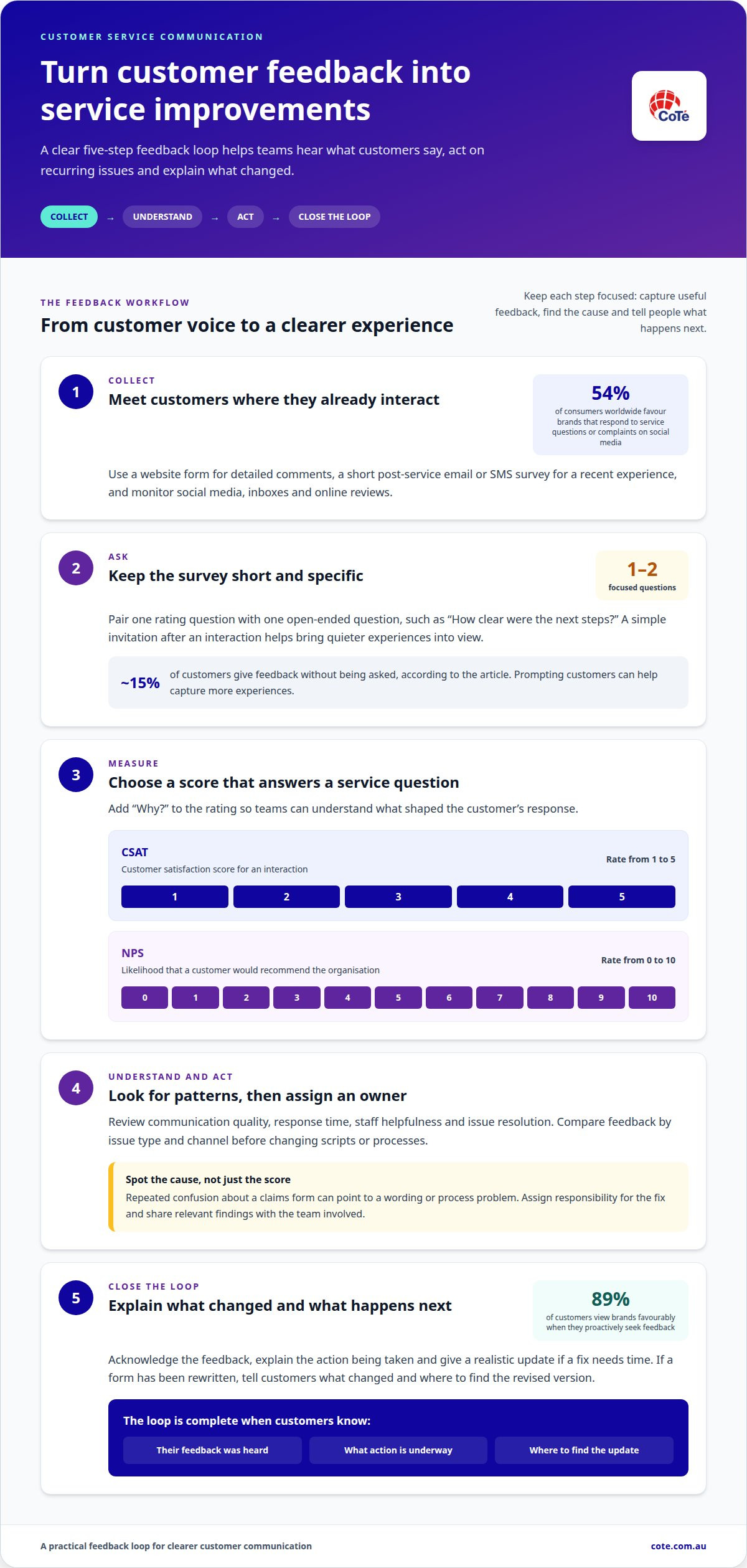
Feedback improves service only when it leads to a decision. Set a clear path from collection to action: capture what customers say, group comments by issue, assign an owner and report what changed. For example, repeated confusion about a claims form points to a wording or process problem, not simply a need for more survey responses.
Use different channels to collect customer feedback where customers already interact. A website form suits detailed comments, while a short post-service email or SMS survey captures a recent experience. Monitor social media, inboxes and online reviews as well. A timely, considered reply shows the concern has reached someone responsible.
Keep surveys focused. A one- or two-question follow-up is easier to answer than a long questionnaire. Ask one rating question and one open-ended question, such as, “How clear were the next steps?” Then review the comments alongside the score. A simple invitation after an interaction helps bring quieter experiences into view.
Choose a measure that answers a specific service question. CSAT, or customer satisfaction score, measures how satisfied someone was with an interaction. Ask customers to rate the service on a scale from 1 to 5. NPS, or Net Promoter Score, asks how likely a customer is to recommend an organisation on a 0 to 10 scale. Add “Why?” to the rating. The explanation reveals what drove the score, rather than leaving teams to guess.
Track communication quality, response time, staff helpfulness and issue resolution after service interactions. A high satisfaction score alongside repeated follow-up contacts can signal that customers felt heard but still didn’t get a complete answer. Compare feedback by issue type and channel, then look for patterns before changing scripts or processes. Share relevant findings with the teams responsible for that part of the experience.
Close the loop with the customer and the team. Acknowledge the feedback, explain the action being taken and give a realistic update when a fix needs time. If a form has been rewritten, tell customers what changed and where to find the revised version. Invite feedback and welcome it.
Active listening, clear communication and positive framing
Listen first. Let the customer finish explaining the issue before planning your response. Then summarise the concern in plain language: “You received a renewal notice, but the premium doesn’t match your previous estimate.” This gives the customer a chance to correct details before you move towards a solution.
Ask focused questions when a detail is unclear. For a delayed utility connection, ask which address and appointment date the customer means. Don’t make them repeat information they’ve already provided. Check the interaction history, confirm the facts and explain what you’ll do next. Active listening turns a broad complaint into a specific issue someone can own.
Emotional intelligence means noticing how a customer is responding and choosing a suitable reply. Someone worried about a rejected insurance claim needs calm, direct explanations, not a rushed script. Acknowledge the impact without agreeing to facts you haven’t checked. For example: “I understand this delay affects your plans. I’ll review the assessment notes and explain the next step.”
Use positive framing without disguising the problem. Replace “We can’t process this without another document” with “Please send the missing document so we can continue the assessment.” The second version gives a clear action without promising an outcome or hiding the requirement. Use short sentences, familiar words and one instruction at a time, especially in written replies.
Match each response to the customer’s question. If they ask when a payment will arrive, don’t send a general explanation of payment policy. State what you know, identify what remains outstanding and explain how the customer will receive an update. Staff can practise with realistic call and email scenarios, then review whether each response answered the original question.
Under the Spam Act 2003, Australian businesses must get customers’ permission before sending commercial electronic messages and include an unsubscribe option. For phone calls, respect customers’ preferences and check the requirements that apply to your business.
Poor communication can cause confusion, repeated contact and damaged customer relationships. Prevent these problems by confirming the issue, recording agreed actions and giving a clear next step. For example, after discussing a disputed account, summarise the information reviewed and the action assigned before ending the conversation.
Building professional and personable customer relationships
Personal service starts with recognising the customer’s situation, not simply adding their name to a template. A wealth manager responding to a portfolio query should address the account or request involved and explain the next step. Keep the tone professional, but make the message specific enough to show that the customer’s time and circumstances matter.
Use a customer relationship management system, or CRM, to give authorised teams a shared view of relevant interactions. A CRM records details such as contact preferences, previous enquiries and follow-up actions. For example, if a customer has already explained a billing issue by phone, the next staff member should see the summary before replying by email. That way, the customer doesn’t have to start again.
Build customer profiles around service needs. Map the customer journey from initial enquiry through application, decision and ongoing support. Each stage raises different questions. An insurance applicant might need clear guidance about documents, while an existing policyholder needs a direct explanation of a renewal change. Use relevant preferences and interaction history to tailor the message, not to add unnecessary personal details.
Personalisation should be useful and consistent. A customer who prefers written updates should receive clear written follow-up, while a complex issue might call for a conversation. Keep the customer’s channel preference current and make sure teams can see it. A tailored message that contradicts another team’s response damages trust instead of strengthening the relationship.
A practical starting point is to review one journey and identify where a generic message leaves customers without useful context.
Good data supports relevant communication; poor data produces awkward mistakes. Give teams clear rules for recording, updating and using customer details. For example, separate confirmed preferences from assumptions, and correct an outdated contact preference when a customer provides a new one. The operational value comes from accessible, accurate records and clear ownership of follow-up, not from software alone.
Review personalisation through real service interactions. Sample messages from different teams and channels, then check whether each uses relevant context, explains the action and avoids unnecessary repetition. If a customer’s case moves from an enquiry team to a specialist, include a concise handover summary. This helps the next interaction feel connected while keeping responsibility for the customer’s request clear.
Choosing communication channels for customer demographics
Choose channels based on customer needs, not internal convenience. An older policyholder managing a claim might prefer a phone conversation, while a customer checking an appointment might prefer SMS. Age alone doesn’t determine preference. Ask customers how they want routine updates, then record their choice where service teams can use it.
Identify preferences by asking a simple channel question during onboarding, service calls or account updates. Review incoming contact patterns by customer group and issue type, then compare them with survey feedback. If customers repeatedly call after receiving an email, it might lack a clear answer or next step. Treat channel use as evidence, not proof of preference, and give customers a practical way to change their choice.
Offer suitable alternatives for different tasks. Email works well for detailed explanations customers need to keep. SMS suits brief reminders or a prompt to review an update. Phone calls help with sensitive or complex conversations, while live chat supports quick questions during stated service hours. Make common information easy to find on your website, without forcing customers to contact staff.
Tools for managing these interactions include customer relationship management systems, shared inboxes, contact centre software and social media management tools. Together, they help teams record contact history, route requests and coordinate replies across email, phone, chat and social media. The right setup gives staff a useful view of the conversation without making customers repeat the same details.
Multiple channels need to deliver one coherent service experience. A customer who starts in live chat and follows up by phone should receive consistent information. Keep approved explanations, service terms and escalation steps aligned across scripts and templates. Adapt the format to the channel, but keep the meaning consistent. Email can include detail; SMS should focus on one action.
Build a channel strategy in a clear sequence: define customer groups and common tasks, ask about preferred contact methods, assign each task to suitable channels, set ownership for incoming requests and review service outcomes. For example, a utility could use its website for outage information, SMS for a brief service alert and phone support for account-specific questions. Check whether customers find the right answer without unnecessary hand-offs.
Offer relevant options, not more channels without a plan. Start with the channels customers use and resource them so enquiries receive clear, consistent responses.
For organisations coordinating customer messages across channels, talk to CoTé about the communication workflow that needs to work better.
CoTé: Virsaic Enterprise and Grow CRM
Virsaic Enterprise is CoTé’s enterprise Customer Experience Management platform, supporting document composition, workflow approvals, signatures and multi-channel delivery. It suits teams managing high volumes of customer documents and messages across complex processes.
Grow CRM supports deals and pipelines, activity tracking, workflow rules, dashboards and a full audit log, giving teams a shared view of customer interactions. Pulse supports email and SMS campaigns.
CoTé’s software is Australian-built and hosted on Microsoft Azure in Australia and the United States. CoTé is ISO/IEC 27001 certified and has a SOC 2 Type II report.
Make the next improvement operational
Improving customer communications is ongoing operational work, not a one-off exercise. Choose a customer journey, identify where messages or hand-offs break down, then assign an owner to improve the workflow. Review the results through real customer interactions and adjust the process when evidence points to a gap.
Ready to improve your customer communications? Request a Virsaic Enterprise platform demo.
Frequently Asked Questions
What is good customer service?
Good customer service helps people make progress without unnecessary effort. A customer contacting a health provider about an appointment, for example, should receive an answer that addresses the request and explains any action required. Service quality also depends on whether staff can access accurate information and resolve the issue within their authority. Customers shouldn’t have to navigate internal structures to find someone responsible.
What is customer communication?
Customer communication is every exchange between an organisation and its customers, from a policy document to a phone call or service alert. It includes the information shared, the channel used and the opportunity for a customer to respond. In a bank, a confirmation message after an account change is part of that communication. So is a staff member’s explanation if the customer questions the change.
What are the best ways to improve customer communication?
Start with a customer journey that causes avoidable effort, such as changing an insurance policy. Trace what customers receive at each stage, identify where they need to chase or repeat information, then revise the process with the teams involved. Test the revised messages against real customer questions. This keeps improvements focused on a task instead of producing general scripts that miss the reason for contact.
How can businesses improve customer service response times?
Reduce delays by directing enquiries to the right team and making ownership visible. Group requests by subject, set priorities based on business impact and route specialist issues to staff with the required authority. Monitor unresolved cases, not just new arrivals. An acknowledgement should tell customers what happens next, rather than suggesting that a complex request is already being resolved.
How can businesses measure customer communication effectiveness?
Use a small set of key performance indicators, or KPIs, tied to customer outcomes. Track whether enquiries are resolved, whether customers need to contact the organisation again and whether messages prompt the intended action. Pair these measures with comments from surveys, complaints and service interactions. If customers misunderstand a letter, compare their feedback with follow-up contacts, revise the wording and monitor whether the confusion continues.
Disclaimer
This article provides general information only and does not constitute legal, compliance or professional advice. Consider your organisation’s specific obligations and seek appropriate advice before making decisions.