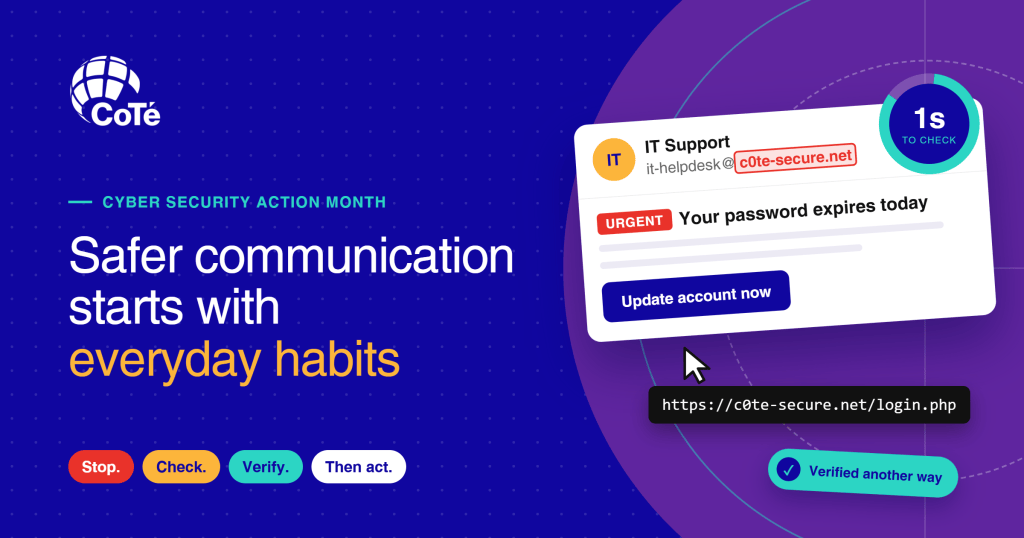
October is Cyber Security Action Month, and this year’s theme is “Take a second. Stay secure.” It’s a timely reminder that cyber security isn’t only an IT responsibility.
Every day, people send emails, share documents, approve requests and communicate with customers and colleagues. Each of those everyday interactions can become an entry point for a cyber threat.
It’s also part of a broader shift this year, with the Australian Signals Directorate’s first Cyber Action Year encouraging organisations to move from awareness to practical action.
That’s what makes modern cyber attacks so hard to spot. They don’t always look suspicious. Often, they look like an ordinary email from a colleague, a familiar supplier, IT support or a manager in a hurry.
So stronger cyber security starts with something simple: helping people recognise when something doesn’t feel right.
1. Cyber threats are harder to recognise
The classic scam email full of spelling mistakes is no longer the only threat to watch for. Modern phishing and social engineering attempts can be polished, convincing and designed to imitate the way your organisation normally communicates.
An email may appear to come from:
- IT support asking you to update your account
- a manager requesting an urgent payment
- a supplier sending an invoice
- a colleague sharing a document
- a customer asking you to open a link or attachment
At first glance, it may look perfectly normal. That’s exactly why awareness matters.
2. Take a second before you click
Cyber attacks often rely on urgency. Your password is about to expire. An invoice must be paid today. Your account will be suspended unless you act now.
That pressure is designed to make people react before they think. Before clicking a link, opening an attachment or responding to an unusual request, take a few seconds to check:
Who actually sent it? Look closely at the sender’s email address, not just the display name.
Does the request make sense? If it’s unusual, unexpected or involves sensitive information, check it through another channel.
Where does the link really go? Hover over links on a computer, or press and hold on a phone, to see the real destination before you click.
Is it creating unnecessary urgency? Pressure to act immediately is a warning sign in itself.
Those few seconds can make a big difference.
3. Verify before you act
One of the simplest cyber security habits is also one of the most effective.
If an email asks you to change bank details, share sensitive information, approve a payment or log in through an unfamiliar link, confirm the request independently, for example by:
- calling the person on a number you already have
- sending a new message rather than replying to the original email
- checking the request through an established internal process
Verification might take an extra minute. Recovering from a cyber incident takes considerably longer.
4. Clear processes make the unusual easier to spot
Many cyber incidents start with ordinary communication: a convincing email, a shared document, a password request, a link that seems to come from a trusted source.
When communication is scattered across inboxes, chat apps and shared drives, documents exist in several versions and nobody is quite sure where a request should come from, it’s harder to notice when something is off.
Clear, consistent processes help people understand what “normal” looks like. When everyone knows how invoices are approved, how documents are shared and where customer information belongs, a request that falls outside that process is much easier to question.
5. Your people are part of your defence
Cyber security is often discussed in terms of firewalls, passwords and software. Those protections matter. But people are an important part of the defence too.
Employees who feel comfortable questioning unusual requests, verifying information and reporting anything suspicious can stop threats before they become incidents.
The goal isn’t to make people afraid of every email. It’s to build a culture where taking a moment to check something is simply normal.
Where CoTé fits
CoTé helps organisations bring communication, document sharing and business processes into structured, consistent workflows, so people know where information belongs and how it should move.
For example, CoTé Share delivers files through secure links with password protection and expiry controls, rather than loose email attachments. Zign electronic signatures come with tamper-evident audit trails, so approvals leave a clear record. When sharing and sign-off follow a familiar path, a request that arrives some other way stands out.
Security is built into how we work, too. CoTé is ISO/IEC 27001 certified and SOC 2 Type II, providing independent assurance over the controls, processes and governance behind our platform and apps.
Stop. Check. Verify. Then act.
Cyber security will always need a combination of technology, processes and people. But it doesn’t begin when something goes wrong. It begins with the small decisions people make every day.
This Cyber Security Action Month, take a second to review not only your security technology, but also the everyday communication habits that can increase or reduce risk.
Talk to us about making secure communication part of how your organisation works.